Golf Cart Storage
San Diego
The right unit, the right battery prep, and secured transport into and out of storage, anywhere in San Diego County. You choose the facility; we handle every mile between.
Key Takeaways
- Discount Movers moves golf carts into and out of any San Diego County storage facility. You pick the unit, we handle both transport legs, frame-strapped on our own flatbed.
- Golf cart storage at Discount Movers’ Miramar facility in San Diego starts at $205 per month.
- A 10×15 drive-up unit fits most 2- and 4-passenger carts; 6-passenger and lifted carts usually need a 10×20.
- Lead-acid batteries go into storage fully charged and need a top-up every 8–12 weeks; lithium packs store best at 50–80% with the disconnect off.
- Coastal San Diego rarely justifies climate-controlled storage for a cart; desert storage is a battery-management problem, not a temperature-comfort one.
- Snowbird service is routine: remote key handoff, photo confirmation at every step, return delivery scheduled before you land.
- Licensed California carrier since 1997: CAL-T #201759, US DOT #4372335. Quotes are free: (858) 490-0155.
By the Discount Movers Team · Published & last reviewed July 31, 2026 · Licensed California carrier · CAL-T #201759 issued by the BHGS · US DOT #4372335
The Direct Answer
Golf Cart Storage
In San Diego
Golf cart storage at Discount Movers’ Miramar facility in San Diego starts at $205 per month. Storing a cart takes two things: the right space, and a legal way to get the cart there. Discount Movers supplies the second: insured, frame-strapped cart transport into and out of any storage facility, garage, or cart barn in San Diego County, and this page supplies the rest: what size unit a cart actually needs, how batteries survive months of sitting, and the checklist we run before every storage move.
Why not just drive it to the unit? Because for nearly every cart and nearly every facility, that trip is illegal. Golf carts are limited to 25 mph streets under CVC §21716, and no self-storage facility sits inside a cart zone. Towing a cart on its own wheels behind a hitch puts stress on a steering column that was never built for it, and a borrowed trailer with the wrong straps is how bodywork gets creased. The correct answer is a proper flatbed deck, ramps, and ratchet straps at the frame, which is what we send.
The service is deliberately simple: store the cart with us, or tell us where you want it stored. Monthly storage at our Miramar facility starts at $205; if you would rather use your own unit, a closer facility or your own garage, we handle both transport legs at a flat rate either way. It’s the same model as our household storage moving service, applied to carts.
Short vs. Long Term
Two Different Storage Jobs
Plan For The Right One
A cart parked for six weeks and a cart parked for a year need different prep. The dividing line is about three months, roughly one battery self-discharge cycle.
| Factor | Short-term (under 3 months) | Long-term (3+ months) |
|---|---|---|
| Typical use case | Between homes; remodel; trying a community first | Snowbird season; estate settling; deployment |
| Battery prep (lead-acid) | Full charge at drop-off | Full charge + top-up visit every 8–12 weeks |
| Battery prep (lithium) | 50–80% charge, disconnect off | Same, checked at ~6 months |
| Tires | Normal pressure | Normal pressure; roll the cart a foot at top-ups to move the contact patch |
| Cover | Optional | Breathable cover on (never plastic film against paint) |
| Unit choice | Anything drive-up that fits | Drive-up + outlet access helps; shade matters inland |
| Booking | Single round trip, one quote | Two scheduled legs; return booked before season |
Military family? Cart storage pairs naturally with a PCS move. One coordination call handles both.
Prep
The Pre-Storage Checklist
We Run Every Time
Ten minutes of prep decides what condition the cart is in when it comes back out. This is the exact list.
Charge to target
Lead-acid: charge full the night before, then check and top off water. Lithium: stop at 50–80% and switch the main disconnect off.
Clear the cart
Chargers, coolers, umbrellas, electronics, and paperwork come out. If it isn’t bolted on, it doesn’t go into storage on the cart.
Photograph everything
Four corners, seat, dash, battery bay. We do the same at pickup. Two sets of timestamps beat one memory.
Set the switches
TOW/RUN to TOW, key out, brake set at the unit (not white-knuckle tight for long holds, a chocked wheel is kinder to the cable).
Cover breathable
Cotton or vented covers only. Plastic sheet traps coastal moisture against the paint and terminals.
Book the return leg
The cart’s exit gets scheduled before the season starts. April to May outbound and October–November return slots fill first in cart communities.
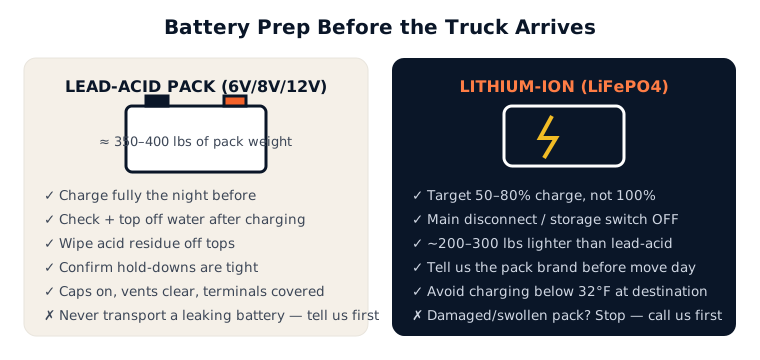
Battery detail (chemistry, charge targets, and why lithium wants a partial charge) lives in the golf cart battery transport & storage guide.
Logistics
Snowbirds, Estates &
Remote Handoffs
Half our storage moves happen while the owner is somewhere else. The process is built for that.
Snowbird rotation: Borrego Springs and desert-community owners store carts through the 110°F summer, coastal owners through travel season. We run the in-and-out legs on a standing schedule: Borrego Springs cart transport is its own page for a reason.
Estates and inheritances: when a cart is part of a settled estate, we pick up from the community (gate coordination included), move it into storage while the family decides, then deliver to the heir, even out of state. Executors get photo documentation at every handoff.
Remote handoff, verified: key from a neighbor, property manager, or the community office; photos of the cart loaded, placed, and locked; unit key returned wherever you say. You see every step from your phone.
FAQ
Golf Cart Storage
Questions, Answered
Cart Going Into Storage?
One call books both legs: into the unit now, back out when the season turns. Flat-rate, frame-strapped, photo-documented.
Free Quote
GET YOUR FREE QUOTE
We respond within 2 hours during business hours (8am–8pm daily). No commitment.