Piano Movers
San Diego
Pianos are irreplaceable. Our trained piano moving crew handles uprights, baby grands, and grand pianos with specialized equipment and meticulous care. Family owned since 1997, we've moved hundreds of pianos safely across San Diego.
The Direct Answer
How Does A Piano Move
In San Diego Work?
An upright piano weighs roughly 300 to 800 pounds and a grand more still, so a piano move is a crew-and-equipment job: piano board, straps, floor protection, and movers who have done it before. We move uprights, baby grands and grands, on their own or as part of a full household move.
The estimate is free and written before the day, based on the piano, the stairs and the two addresses; there is no deposit, ever. Call (858) 490-0155 with the piano type and the access at both ends, and you will have the number the same day.
All Piano Types
Which Piano
Are You Moving?
Every piano type requires a different approach. Our crew is trained and equipped to handle all three safely and efficiently.
Piano Moving
Upright pianos (also called vertical pianos) typically weigh 300–800 lbs and require careful handling to protect both the instrument and your home's floors and doorframes.
- Professional piano board and straps used for every move
- Furniture pads protect the piano's finish and your walls
- Floor runners protect hardwood and tile floors
- Crew trained specifically for upright piano handling
- Stairs, hallways, and tight spaces, no problem
Baby Grand & Grand Piano Moving
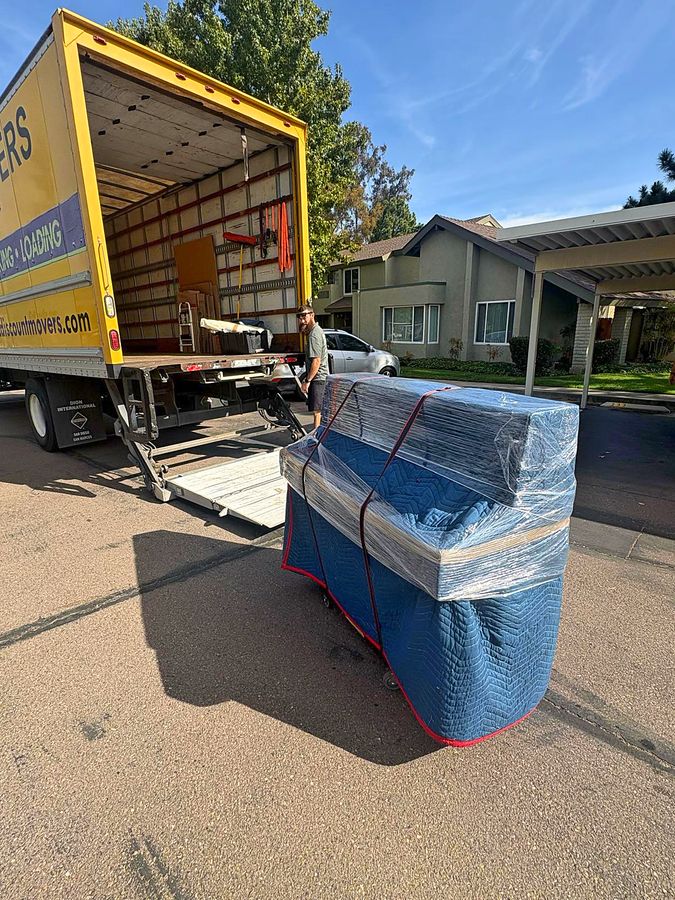
Grand and baby grand pianos must be carefully disassembled before transport. The legs are removed, the lid is secured, and the entire piano is wrapped and placed on a specialized piano skid board for safe moving.
- Piano legs safely removed and individually wrapped
- Piano body placed on specialized grand piano skid board
- Entire instrument wrapped in moving blankets and stretch wrap
- Fully reassembled and positioned at destination
- Suitable for baby grand, parlor grand, and concert grand
Our Process
How We Move
Your Piano Safely
Piano moving requires specialized training and equipment. Here's the exact process our crew follows for every piano move.
Free In-Home Assessment
We assess your piano type, weight, current location, stairways, doorway widths, and destination setup before providing your quote. Straightforward pricing.
Floor & Doorframe Protection
We lay floor runners and pad doorframes before moving a single inch. Your home is protected throughout the entire move.
Piano Preparation
For upright pianos, we secure the lid and wrap the instrument. For grands, we remove the legs, secure the lid, and place the body on a piano skid board.
Safe Transport & Placement
The piano is loaded, secured in the truck, and transported carefully. At the destination, we position the piano exactly where you want it and reassemble everything.
Why Choose Us
Why San Diego Trusts
Discount Movers For Pianos
Pianos are not just heavy, they're irreplaceable family heirlooms and precision instruments. Here's why we're the right choice.
Specialized Equipment
Piano boards, skid boards, heavy-duty straps, and moving blankets specifically designed for piano transport.
Trained Piano Crew
Our movers are specifically trained on piano handling techniques, not just general moving best practices.
Fully Insured
Every piano move is covered by our liability and cargo insurance. Basic valuation is included at 60¢ per pound per article; full replacement value protection is available for an additional charge. Ask when you book.
What Your Piano Actually Weighs
Manufacturers publish net weights, and the spread between models is wide. Steinway lists its Traditional K-52 upright, 52 inches tall, at 650 pounds. Among its grands, the Model S baby grand at 5 feet 1 inch is listed at 579 pounds, the Model M at 5 feet 7 inches at 664 pounds, the Model B at 6 feet 11 inches at 802 pounds, and the Model D concert grand, 8 feet 11 3/4 inches long, at 1,125 pounds. Those are factory figures for one maker. Older instruments and other brands differ, which is why we ask for the make and model, or a photo of the nameplate, when you call.
The weight drives two decisions we make before the day. The first is crew size: a 579-pound baby grand on a ground floor and an 1,125-pound concert grand coming down a flight of exterior stairs are not the same job and do not get the same crew. The second is the route. Once the legs are off, the body of a grand travels on its side on the skid board, so the tight point is the doorway or the stair landing rather than the room the piano lives in. Measure both if you can, and tell us about any turn in the staircase.
Your Piano Estimate Under California Law
California regulates how a licensed mover quotes any household move, and a piano is no exception. The Bureau of Household Goods and Services states that a mover may provide an estimate in writing only after a visual inspection of the items to be moved, and that verbal estimates or estimates given over the internet are illegal and may not be enforceable. For a piano, that inspection is where the stairs, the doorway widths and the landing at each address get looked at rather than described, and it is why the assessment comes before the number.
The same BHGS guidance says the estimate must carry a Not to Exceed price, the maximum you can be charged unless you request additional services, and any such addition has to be written up on a Change Order for Moving Services. A Change Order cannot be used simply because the mover underestimated the job. BHGS also advises that you have the estimate in hand at least three days before moving day. On a piano estimate, ask that the stairs and the crew size discussed at the assessment appear on the document itself, so the Not to Exceed figure already reflects the access the crew will meet.
Every California household mover must also display its Cal-T permit number on its vehicles, and BHGS encourages customers to run that number through its online license search, where a valid permit shows a Carrier Status of Active. Discount Movers operates under CAL-T #201759, issued by the BHGS, and US DOT #4372335. Both numbers are printed on this site, and either one can be checked in a few minutes before the truck is booked, which is a reasonable step for an instrument that cannot be replaced.
Where The Piano Should Land
Decide the piano's final spot before the crew arrives, because a grand is reassembled where it is set down and an upright is walked off the board into place. Steinway's care guidance recommends a room climate of 40 to 60 percent relative humidity and 68 to 78 degrees Fahrenheit, and says the piano should be kept out of the path of sunlight and away from direct air from heating or cooling vents, and not placed close to a humidifier. Walk the room with that list in hand and mark the wall with tape so the crew has no question about where it goes.
On tuning, Steinway's authorized service program says tunings should be scheduled at a minimum of six-month intervals, and that a piano which has missed those intervals may need to be tuned more than once in the same visit for the tuning to hold. If your piano was already overdue before the move, tell the technician that when you book the post-move visit, so the appointment is long enough for a second pass if the instrument needs one.
FAQ
Piano Moving
Questions Answered

Moving a Piano in San Diego?
Call us for a free custom piano moving quote. We'll assess your instrument and give you an accurate estimate with no obligation.
Free Quote
GET YOUR FREE QUOTE
We respond within 2 hours during business hours (8am–8pm daily). No commitment.