Golf Cart & LSV Law
In California
The Vehicle Code gives golf carts a tiny legal territory and LSVs a slightly bigger one. Here is exactly where each may drive, section by cited section, and why everything else travels by truck.
Key Takeaways
- A golf cart cannot be driven on most California public roads: CVC §21716 restricts carts to streets in 25 mph zones, and §21115 designations only cover specific streets near golf courses.
- CVC §345 defines a golf cart: three or more wheels, under 1,300 lbs unladen, 15 mph maximum design speed, golf equipment plus no more than two people.
- An LSV under CVC §385.5 is a different machine: 20–25 mph capable, under 3,000 lbs GVWR, DMV-registered with a VIN, and may use roads posted 35 mph or less (§21260).
- Golf carts operated per §21115 are exempt from registration (§4019). The trade-off is a tiny legal operating territory.
- Because of those limits, nearly every cart relocation in San Diego County legally requires hauling, which is what a licensed carrier like Discount Movers (CAL-T #201759, US DOT #4372335) does.
- This is general legal information, not legal advice; statutes are linked to official sources below.
By the Discount Movers Team · Published & last reviewed July 31, 2026 · Licensed California carrier · CAL-T #201759 issued by the BHGS · US DOT #4372335
The Direct Answer
Can You Drive A Golf Cart
On California Roads?
Mostly, no. California Vehicle Code §21716 says no person shall operate a golf cart on any highway except in a speed zone of 25 miles per hour or less, and even inside those zones, carts generally rely on streets a local authority has designated for cart use near a golf course under §21115. A golf cart is not a small car in the eyes of the DMV; it is a purpose-built machine with a deliberately tiny legal territory. Everywhere outside that territory, a cart travels by truck.
That single fact explains this entire service category. When a cart changes homes (Rancho Bernardo to Ocean Hills, an estate in Borrego Springs to a grandchild in Poway) the route crosses arterials, climbs freeway corridors, and leaves every designated zone. Driving it there isn’t a gray area; it’s a citable offense with your insurance nowhere in the conversation. Hauling it in a flatbed trailer is the legal path, and it’s the service we run daily.
Below: the exact classifications, the LSV rules that confuse everyone, and a five-step legality check you can run on any route. Every section number links to the official code text.
Classification
Golf Cart vs. LSV vs. NEV
Three Names, Two Machines
“NEV” and “LSV” are the same legal machine, CVC §385.5 says a low-speed vehicle “is also known as a neighborhood electric vehicle.” The real distinction is cart vs. LSV, and it decides everything: registration, insurance, and which streets are legal.
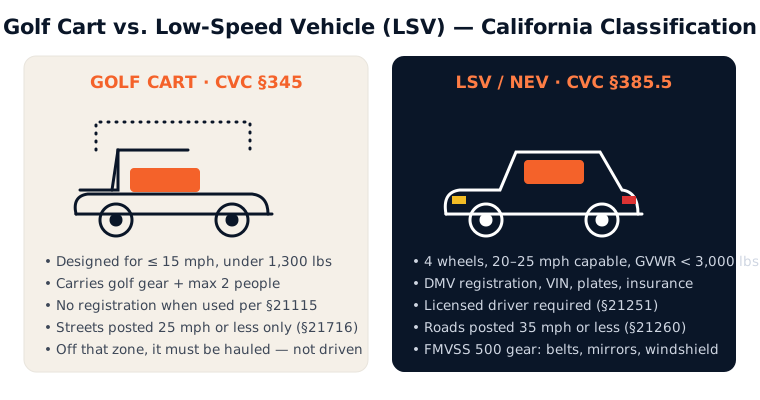
| Requirement | Golf cart (CVC §345) | LSV / NEV (CVC §385.5) |
|---|---|---|
| Design speed | Not more than 15 mph | More than 20, not more than 25 mph |
| Weight | Under 1,300 lbs unladen | Under 3,000 lbs GVWR |
| Wheels / seats | 3+ wheels; driver + 1 passenger | 4 wheels |
| DMV registration | Exempt when operated per §21115 (§4019) | Required, VIN, plates, fees |
| Driver’s license | Required on a public street (§12500); §4019 exempts the cart from registration, not the driver from a license | Required (§21251 applies motor-vehicle rules) |
| Insurance | Specialty/homeowner policies typical | Auto-style liability required |
| Legal streets | 25 mph zones + §21115 designations | Roads posted 35 mph or less (§21260) |
| Safety equipment | None mandated beyond design | FMVSS 500: windshield, belts, mirrors, lights, reflectors, VIN |
Official text: §345 · §385.5 · §21716 · §21115 · §21115.1 · §21260 · §4019
The Cart Rules
Where A Golf Cart May
Legally Operate
The 25-mph ceiling (§21716). “Except as provided in Section 21115.1 and Chapter 6 (commencing with Section 1950) of Division 2.5 of the Streets and Highways Code, no person shall operate a golf cart on any highway except in a speed zone of 25 miles per hour or less.” In practice: residential streets inside cart communities qualify; collector roads, arterials, and anything with a 30+ sign do not.
Designated cart streets (§21115). A city or county may designate streets for combined cart use when the street is adjacent to or provides access to a golf course (or sits within a golf-course real-estate development), is built to safely carry both cars and carts, and (outside a development) extends no more than one mile from the course. That one-mile leash is why cart culture concentrates around courses rather than across a city. Inside the City of San Diego the mechanism is on the books by name: the Municipal Code carries a Rancho Bernardo Golf Cart Ordinance (Chapter 8, Article 4, Division 16) and a Rancho Penasquitos Golf Cart Ordinance (Division 17), each having the City establish a cart zone within a mile of the golf course boundaries, leave out the streets where cart operation “would not be consistent with public safety,” and post signs so the zone is readable on the ground. Which streets qualify in any given community is a question for that community office and for the signs, not for a general rule.
Designated crossings (§21115.1). Cart crossing zones may be established on streets posted 45 mph or less immediately adjacent to a golf course: approximately 90 degrees to the roadway, daylight hours only, and only after the law-enforcement agency with jurisdiction signs off on signage and safety. No designated crossing, no legal crossing.
The registration trade-off (§4019). A golf cart operated pursuant to §21115 is exempt from DMV registration. The exemption is convenient and misleading in equal measure: people read “no registration needed” as “drive it anywhere,” when it actually means “legal only inside the designated bubble.”
The LSV Rules
Street-Legal Carts Are
A Different Machine
A street-legal “cart” is legally not a golf cart at all. It’s a low-speed vehicle. To be one, the machine must meet the federal FMVSS 500 equipment standard (windshield, seat belts, mirrors, head/tail/stop/turn lamps, reflectors, parking brake, 17-digit VIN), carry DMV registration and plates, and be driven by a licensed, insured driver, because §21251 applies the motor-vehicle rulebook to LSVs.
What the LSV buys you is range: roads posted 35 mph or less (§21260), plus crossings of faster roads at approximately 90-degree intersections that begin and end on 35-or-less streets. What it doesn’t buy you: arterials, highways, or any uncontrolled state-highway crossing without specific approval. GEM, Evolution, ICON, and factory street-legal Club Car/E-Z-GO builds all live under these rules.
Moving an LSV works exactly like moving a cart (frame-strapped, door to door) with one addition: the registration travels with the vehicle. Both ride our standard cart transport service, and out-of-state deliveries follow the destination state’s rules, which differ (Arizona’s cart-friendly retirement suburbs register carts California wouldn’t; details on the shipping page).
Route Check
The Five-Step Legality Check
Before Any Cart Drive
This is the checklist behind the HowTo schema on this page, run it on any proposed route before putting a cart on a public street.
Classify the machine
Under 1,300 lbs and 15 mph with 2 seats: golf cart (§345). Four wheels, 20–25 mph, VIN and plates: LSV (§385.5). Everything downstream depends on this.
Map the speed zones
Cart: every segment must be 25 mph or less (§21716). LSV: every segment 35 mph or less (§21260). One faster block fails the route.
Confirm local designation
Carts additionally need the street designated under §21115, ordinance, not habit. The city clerk or community office knows.
Audit the crossings
Cart crossings: designated, ~90°, daylight only (§21115.1). LSV crossings: between 35-or-less segments at ~90°; uncontrolled state-highway crossings need explicit approval (§21260).
Fail any step? Haul it
A licensed, insured carrier is the lawful fallback, and for anything beyond your own community, the practical default.
Moving day is the classic failure case: the new house is 14 miles and six arterials away. That’s not a route; that’s a flat-rate cart move.
Golf Cart Services & Guides
This page is general information about California law as published in the Vehicle Code, not legal advice. Statutes change and cities adopt local ordinances; verify current law at leginfo.legislature.ca.gov or with the California DMV before relying on it.
FAQ
California Cart Law
Questions, Answered
Route Fails The Legality Check?
Then the cart rides with us: frame-strapped, licensed, insured, and delivered to the exact space. Flat quote in one call.
Free Quote
GET YOUR FREE QUOTE
We respond within 2 hours during business hours (8am–8pm daily). No commitment.