Kensington Movers
2 movers, $119 an hour cash. No deposit. Streetcar-era Spanish homes under a mature canopy, on streets that were never drawn for a 26 foot truck.
By the Discount Movers Team · Updated August 2026 · CAL-T #201759 issued by the BHGS · US DOT #4372335 · BBB A+ Rated
The Direct Answer
What Does A Move
In Kensington Cost?
Discount Movers charges $119 an hour cash for two movers and a truck in Kensington, on our own published ladder that runs to $269 an hour cash for five movers. The three hour minimum is $357, there is a flat $75 fuel fee, and there is no deposit, ever.
What moves the number here is streets sized for the streetcar era: kensington's streets were platted when families walked to the Adams Avenue streetcar, and they are narrow by modern standards, with cars parked along both sides on many blocks. Full rate card and instant estimate (about 30 seconds).
Housing Stock & Access
Kensington Homes
& Access
Nothing about Kensington was drawn with a moving truck in mind, and that is the charm and the challenge in one. The neighborhood dates to the streetcar era of the 1910s and 20s, and its Spanish style homes sit on narrow streets under a canopy that has had a century to grow. Curb space is short, limbs hang low, and the houses bring period doorways and tile that reward a careful crew over a fast one.
Streets sized for the streetcar era
Kensington's streets were platted when families walked to the Adams Avenue streetcar, and they are narrow by modern standards, with cars parked along both sides on many blocks. A full size truck can work here, but the position is chosen, not found. We plan where it stands so the street stays passable and the ramp still lands where the crew needs it.
A century of canopy
The mature trees are much of why Kensington looks the way it does, and they hang low over several blocks. A full height box does not clear every limb, so we check the street before the day and position where the roof of the truck and the trees stay out of each other's way. It is a small check that prevents an expensive kind of surprise.
Spanish homes with original detail
The 1920s Spanish houses here keep arched doorways, original tile, wrought iron and plaster that has survived a hundred years and should survive the move. Furniture paths get padded, arches get wrapped at the tight turns, and oversized pieces get disassembled rather than forced. The houses are the point of Kensington, and we move people out of them like we know it.
Adams Avenue is the one way through
The commercial spine along Adams Avenue is narrow, busy and lined with parked cars, and neighborhood events close or slow parts of it at times through the year. It is also the natural approach to most of Kensington. We time the truck's arrival around the avenue's rhythm and come in from the calmer side when the day calls for it.
Short frontages and shared curb
Lots here are compact and the curb in front of any one house is short, often shorter than the truck. That means borrowing frontage from a neighbor's stretch of curb, which goes better when your own cars held the space overnight and the neighbors know the truck is coming. A word over the fence the day before is genuinely part of the plan.
Every Kensington address is different. Send us a photo of the street and the entrance and we will tell you what the access means for your crew size, your carry and your estimate.
📞 (858) 490-0155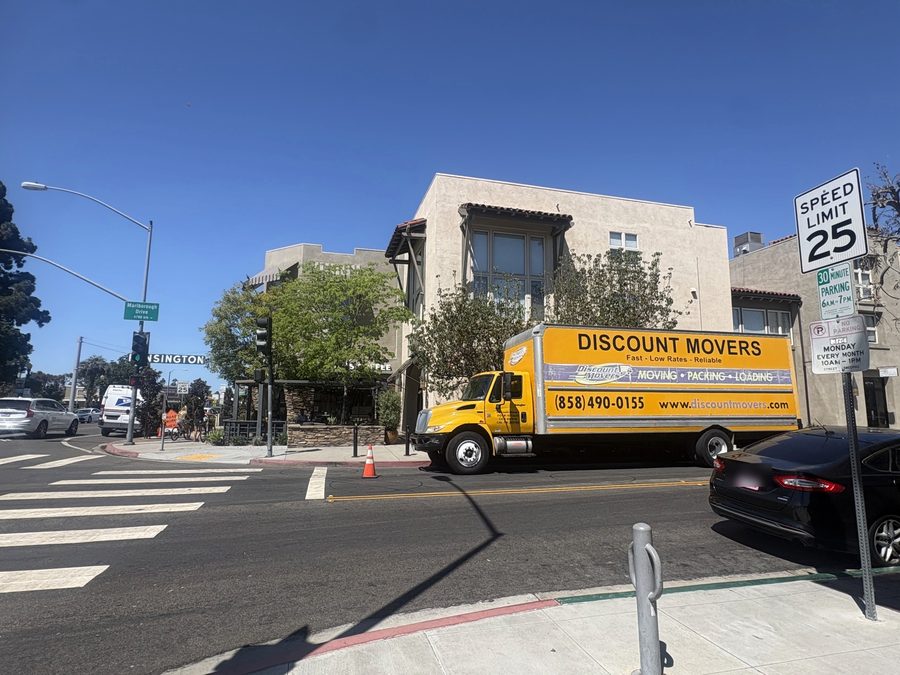
Where We Work
Kensington
Areas We Cover
Five Subdivisions Under One Name
Kensington reads as a single neighborhood from Adams Avenue, but it was never platted as one. Kensington Park was mapped in 1910 and its lots opened for sale later that same year, taking its name from the London district. Kensington Park Annex, Kensington Park Extension, Kensington Manor and Kensington Heights followed as separate subdivisions, each drawn on its own terms. The seams did not disappear. Street pattern and lot sizes change as you cross from one tract into the next, which is why two Kensington houses a short walk apart can hand a truck completely different problems.
So the first thing we ask on a Kensington booking is which of those tracts your street sits in, before we ask anything about the house. A compact Kensington Park lot with a single-width drive is a different job from a Kensington Heights lot laid out later under a different set of standards. The hourly rate does not move, since our ladder runs $119 for two movers, $169 for three, $219 for four and $269 for five at every address in San Diego. What moves is crew size and carry length, and those are what actually decide the bill.
North Of Adams: The Davis-Baker Standards
Kensington Heights, the ground north of Adams Avenue overlooking Mission Valley, was developed from 1926 by the Davis-Baker Company with Richard Requa as supervising architect. Davis-Baker built the houses first and sold the lots afterward, and imposed aesthetic standards on what went up. That one business decision is the reason the Spanish Revival concentration in Kensington is heaviest north of Adams instead of scattered evenly across the whole mesa.
For a mover that is a map, not a history lesson. The original material in Kensington is not evenly distributed, and knowing which side of Adams Avenue an address sits on tells us roughly what the crew is walking into before anyone has sent a single photo. North of the avenue we plan on finding period openings and finishes intact and staff the job with that in mind. Out toward the Talmadge edge and south of Adams the mix is broader and a house may hand us a straight modern hallway instead. Same neighborhood name, different day.
The Sign That Hangs Over Adams Avenue
The neon Kensington sign spans Adams Avenue near Kensington Drive. The community put the original up in the 1950s, the sign is a designated City historical resource, and the one hanging today is a historic replica of it. What matters operationally is its shape: this is not a monument set back on a corner, it is an overhead span held by cables between poles on either side of the roadway.
Any high-box truck traveling Adams passes under it. We do not publish a clearance figure for that span and we will not repeat one somebody else published, because we cannot measure it and a wrong number on a moving company page is how a roof comes off. What we do instead is route and position with the span in mind, deciding which side of it we approach your block from before the truck leaves the yard in Miramar. If your address sits past the sign relative to our approach, that gets settled when we schedule, not at eight in the morning with a loaded street behind us.
The Cobblestone Pillars At The Entrances
Several of Kensington's subdivision entrances are marked with cobblestone boundary pillars and stone gateways. They are among the most recognized pieces of the streetscape here and they are designated historic fabric, not decorative curbing that a contractor pours back on a Tuesday afternoon.
For a truck they narrow the effective width of the entry. A driver who cuts the corner tight off Adams at a pillared entrance is asking a great deal of the rear duals and the box corner at the same moment. Our crews swing wide instead, which occasionally means running one block past your street and coming back around to enter on a better line. That costs seconds. The alternative costs a piece of the neighborhood. If your street has pillars at its mouth, say so when you book so it is in the routing rather than a surprise for the driver.
Every Approach To Kensington Climbs
Kensington sits on a mesa bounded by canyon slopes, dropping away to Mission Valley on the north and Ward Canyon on the west. There is no flat way in. Every approach climbs onto the mesa, and a truck that comes up empty in the morning goes back down full in the afternoon.
For a full-size moving truck the standard approach is SR-15 to the Adams Avenue exit, then east along Adams into the neighborhood. The alternative comes off I-8: the Fairmount Avenue exit, then south, with Fairmount climbing out of Mission Valley up to the Kensington and Talmadge level. That is a loaded-truck grade rather than a flat run, so it is not what we use by default. It is what we use when Adams Avenue is closed for an event, and Adams closes for events often enough here that having the second answer ready is not optional.
Pepper Trees Stand In The Parkway, Not The Yard
The canopy Kensington is known for is largely mature California pepper trees, kept in the parkway strips since the neighborhood's early years. Their protected status has been a live neighborhood dispute rather than a settled matter, which is genuinely useful to know before you call anyone about a branch that is in your way the week of a move. These are not trees in your yard that you decide about.
Pepper trees also have a low, weeping habit rather than a high vase-shaped one, and pruning across Kensington's parkways is uneven from block to block and sometimes from house to house. The consequence for a move is that the workable stretch of curb is frequently not the stretch directly in front of your door. That turns into carry length, and carry length is one of the few variables that reliably changes what a Kensington move costs on an hourly rate. It is also the reason we would rather look at your block than describe it in the abstract.
The 1920s Lamp Posts And The Replica Program
Kensington's ornamental acorn and crown streetlamp posts date to the 1920s, and the City has been replacing them over time with near-identical replicas. They are a large part of why the neighborhood looks the way it does after dark, and they stand exactly where a moving truck wants to work.
We treat them the way we treat the cobblestone pillars, as fixed objects on the street that a truck plans around instead of testing. Swinging a ramp down, opening a rear door or backing into a space beside one of these posts gets more caution from our drivers than the same maneuver beside a modern galvanized pole, because a replica of a 1920s casting is not a part you order on Monday and install on Thursday. On blocks where a post sits mid-frontage we usually take the space on the other side of it and add a few feet of carry.
Copeland Avenue And The Franklin Elementary Frontage
Kensington falls in San Diego Unified's Hoover High cluster, and Franklin Elementary on Copeland Avenue is the in-neighborhood elementary school. Attendance areas in San Diego Unified are assigned per address rather than by neighborhood, so confirm your particular street with the district instead of relying on any neighborhood-level rule, including this one.
Copeland Avenue is a narrow residential street off the Adams Avenue corridor, and Franklin fronts it directly. Morning drop-off and afternoon pick-up put both parked cars and queuing cars along that frontage, on a street that was not sized for either. If your move is on or near those blocks we set the truck before school traffic or after it rather than working through the middle of it. That is a scheduling conversation worth having when you book, because the alternative is a crew standing next to a truck it cannot reposition.
City Of San Diego, Council District 9
Kensington is entirely inside the City of San Diego. It is not unincorporated County, and it sits in City Council District 9. City services apply here rather than County services, and that is the operative fact whether the subject is the parkway tree, the streetlamp, the sidewalk or the trash bin. It also means the historic designations covering the sign and the streetscape are City designations.
For the utility transfer list: electric and natural gas are San Diego Gas and Electric. Water and sewer are City of San Diego Public Utilities. Trash and recycling at single-family homes is City of San Diego Environmental Services. Internet is generally Cox or AT&T. Start those calls before the truck is booked rather than after, and leave the power on at the origin through load day. Electricity is the one service you do not want turning off ahead of schedule in a house with 1920s interior lighting.
When A Kensington Move Needs A Second Truck
A second truck adds $150 plus a second $75 fuel charge to a local job. Across most of San Diego that is purely a volume decision. In Kensington it is also a frontage decision, because the curb belonging to any one house here rarely holds two trucks nose to tail, and stacking them on the same block face turns a workable street into a closed one.
So when a Kensington job genuinely needs the second truck, we do not plan on parking both in front of the house. One works the address and one stages away from the block and swaps in as it fills. That is a dispatch call we make in advance from your address and your inventory, not something the crew improvises at the curb. Tell us about your block when you book and we will make it correctly the first time.
Leaving Kensington For Another State
A long distance move out of Kensington is one flat rate, agreed in writing before we load. It is not the hourly ladder, and we will not put a figure to it before we know what is in the house. The load day itself is still a Kensington move with all of the same planning attached: the span over Adams, the pillars at the entrance, the pepper trees in the parkway, the borrowed frontage. Only the shape of the price changes.
On timing, we cover 550 miles a day starting the day after we load. Inside 200 miles, which takes in all of Los Angeles, delivery is the same day. What we do not do is international shipping, container or POD service, or vehicle transport. If your plan involves a container parked at a Kensington curb for a week while you fill it at your own pace, that is not a service we offer, and on these block faces it is not a small ask of your neighbors either.
What Our Crews Plan For Here
FAQ